
The 30-Second Answer
Two of these words describe the brain, one describes the heat:
- Micom = a microcomputer (the brain). Fuzzy Logic = a smarter version of that brain that adjusts time and temperature automatically.
- IH (Induction Heating) = a heating method that heats the whole pot electromagnetically, instead of a single plate underneath.
- So the real ladder is: Micom/Fuzzy Logic → IH → Pressure IH — rising in price, evenness of cooking, and rice texture.
If you have ever stared at a Japanese rice cooker spec sheet wondering why one says “Fuzzy Logic”, another says “Micom”, and a third says “IH”, you are not alone — it is the single most confusing part of choosing a cooker. The good news: once you know which word describes the control system and which describes the heating system, the whole range suddenly makes sense. This guide explains all three in plain English, shows how they affect your rice and your budget, and points you to the right model. Browse everything in our Japanese rice cooker collection.
At a Glance: Micom vs IH vs Pressure IH
| Micom / Fuzzy Logic | IH | Pressure IH | |
|---|---|---|---|
| How it heats | Heating plate under the pot | Whole pot, electromagnetically | IH + added pressure |
| The “brain” | Microcomputer / Fuzzy Logic | Microcomputer (always) | Microcomputer (always) |
| Rice texture | Great everyday rice | Fluffier, more even | Sweetest, springiest |
| Price from | £179.90 | £339.90 | £599.90 |
| Best for | Everyday rice & tight budgets | A clear step up in texture | Daily rice eaters who want the best |
First, Clear Up the Confusion: “Brain” vs “Heat”
Most buyers think Micom, Fuzzy Logic and IH are three competing options on the same shelf. They are not. Micom and Fuzzy Logic describe the control system — the computer that decides how to cook — while IH describes the heating system. A modern cooker has both, which is why the same model can be “Fuzzy Logic and IH”. Here is what each term actually means.
What is Micom?
“Micom” is short for microcomputer. A Micom rice cooker has a small computer chip that follows pre-programmed cooking curves — adjusting time and temperature through soaking, boiling, steaming and resting stages — rather than a simple on/off thermostat like a basic rice cooker. If you see “Micom”, it simply means the cooker is computerised.
What is Fuzzy Logic?
Fuzzy Logic is a smarter type of Micom. Instead of following one fixed program, it makes small real-time adjustments — sensing temperature and timing and fine-tuning the cook for the conditions. In practice this means more forgiving, more consistent rice, and dedicated menus for white, brown, sushi, porridge and quick-cook rice. Almost every quality Japanese cooker today uses Fuzzy Logic; the question is what heating method sits underneath it.
What is IH (Induction Heating)?
This is where texture really jumps. A standard Micom cooker heats the inner pot from a single plate at the bottom. An IH (Induction Heating) cooker turns the entire inner pot into the heating element — an electromagnetic field heats the metal pot directly, all around, with precise and powerful control. The result is more even cooking, fewer hot spots, and noticeably fluffier rice. IH is the technology behind almost all mid- and high-end Japanese cookers.
…and Pressure IH
The top tier adds pressure on top of IH. Raising the internal pressure lets the rice cook above the normal boiling point, breaking down starches for the sweetest, springiest, most “restaurant-grade” texture — especially noticeable with brown rice and premium short-grain varieties. It is the most expensive tier, and the gap between a great IH model and Pressure IH is one of refinement rather than night-and-day. Much of that final texture also comes down to the pot itself — see our guide to Japanese rice cooker inner pots.
Heating Method, Side by Side

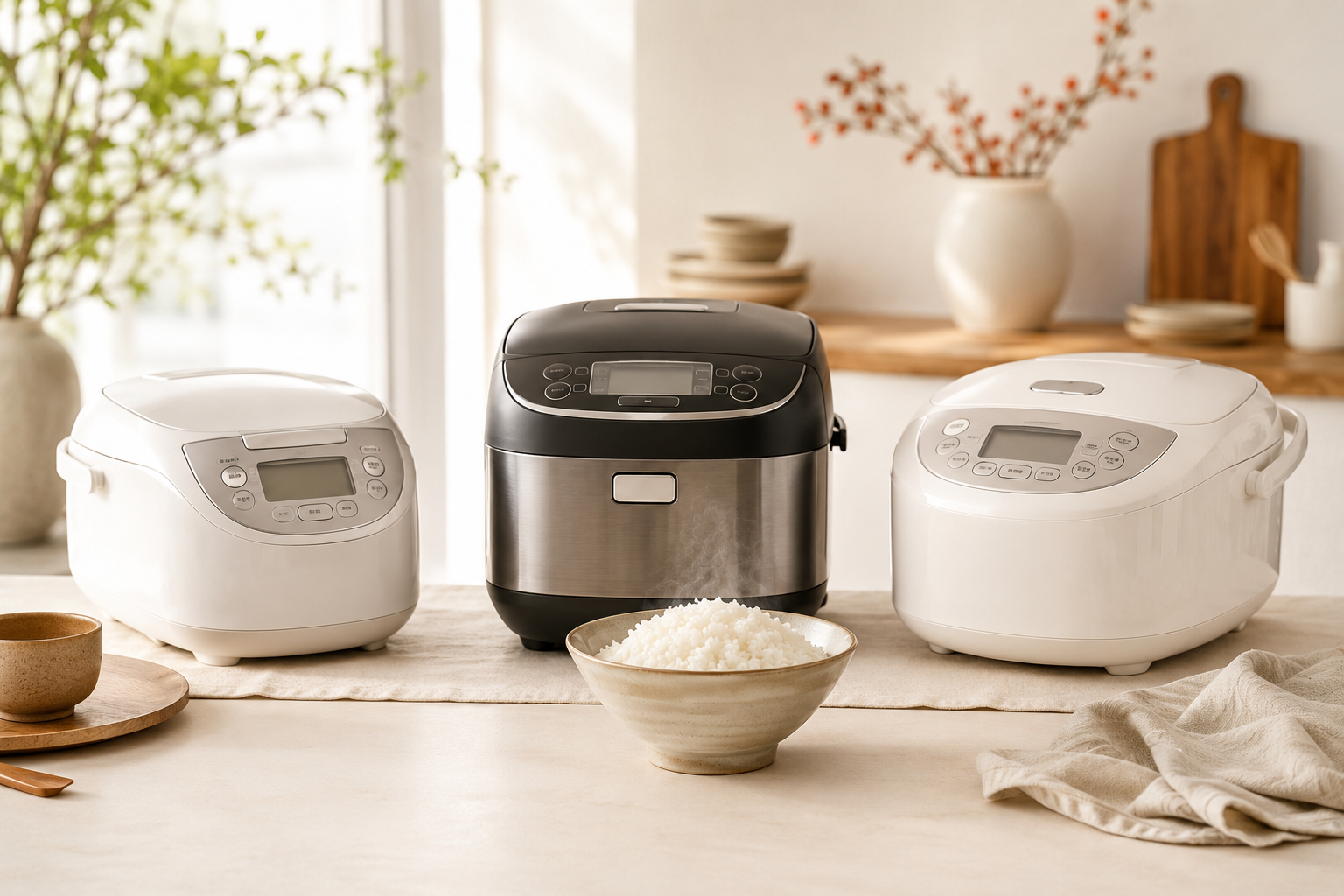
Micom heats from a single plate beneath the pot; IH heats the whole inner pot electromagnetically for more even cooking.
- Evenness: Micom heats from below; IH and Pressure IH heat the whole pot — so the higher tiers cook grains more uniformly with fewer undercooked or scorched patches.
- Texture: Micom gives lovely everyday rice; IH makes it fluffier and glossier; Pressure IH makes it sweeter and springier.
- Keep-warm: Higher tiers hold rice fresher for longer without drying it out — useful if your household eats at different times.
- Versatility: All three handle brown rice, porridge and mixed rice; the pricier the model, the better it tends to do the trickier grains.
So Which One Should You Buy?
Best for a small household (1–2 people)
A compact Fuzzy Logic model in the 0.5–0.9L range is plenty — rice cookers cook best at least one-third full, so don’t over-size. The Panasonic SR-DM (from £179.90) is our go-to value pick.
Best everyday value (small families)
A 1.0L Fuzzy Logic or entry IH cooker is the sweet spot for most homes. The Tiger JBV-S Tacook even cooks a side dish at the same time as the rice, while the Panasonic SR-FC Diamond Kamado IH brings true IH heating at a sensible price.
Best possible texture
If rice quality is your top priority and you eat it most days, go Pressure IH. The Zojirushi NW-YAQ Pressure IH is the gold standard for sweet, springy rice and outstanding keep-warm.
Best on a budget
You do not need IH to eat brilliant rice. A modern Fuzzy Logic cooker delivers excellent results for under £200 — spend the difference on better rice instead. See our best value Japanese rice cookers guide for picks at every budget.
Buying in the UK: Voltage, Plugs & “Made in Japan”
Every Zojirushi, Tiger, Panasonic and Toshiba cooker we sell is the 220–240V UK version with a fitted 3-pin plug. You will not need a voltage transformer or travel adapter — unlike Japanese-domestic models built for the 100V market, which run unreliably (or unsafely) on a transformer.
All units come with UK-based support and our optional HappyCare extended warranty.
One brand makes the three tiers unusually easy to compare: every Toshiba rice cooker we stock is built in Japan, and the range covers all of them. The RC-AMXH is conventional heating, the RC-BHH is 3D IH, and the RC-DS and RC-DX add vacuum soaking on top of pressure IH — so you can step up one tier at a time without changing brand, pot design or control layout.
A quick word on “Made in Japan”: it is a genuine quality signal for inner-pot engineering and build, and many premium models are still Japanese-made — but some excellent cookers are built in other Panasonic, Tiger or Zojirushi factories to the same standards. Don’t treat it as the only marker of quality; the heating tier and inner pot matter more to your rice. Every cooker we stock is 100% genuine, sourced for the UK market.
Shop by Technology


Prefer to browse by brand? Explore Zojirushi, Panasonic rice cookers and Tiger, or see the full Japanese rice cooker range.
The Bottom Line
- Micom / Fuzzy Logic describes the brain; IH / Pressure IH describes the heat. Modern cookers have both.
- Spend up the ladder — Fuzzy Logic → IH → Pressure IH — only as far as your budget and how often you eat rice justify.
- For most UK households, a Fuzzy Logic or entry IH model is the value sweet spot; daily rice lovers should consider Pressure IH.
Ready to go deeper? Our complete Japanese rice cooker buying guide compares Zojirushi, Tiger and Panasonic side by side.
Further Reading
- Japanese Rice Cooker UK Buying Guide (Zojirushi, Tiger & Panasonic)
- Japanese Rice Cooker Inner Pots Explained (All Brands)
- Zojirushi vs Tiger: Which Brand Wins?
- The Zojirushi Master Rice-Washing Technique
Frequently Asked Questions
Q: Is Fuzzy Logic better than a basic rice cooker?
A: Yes. A basic cooker uses a simple on/off thermostat, while a Fuzzy Logic cooker uses a microcomputer to adjust time and temperature through each cooking stage. The result is more consistent rice and dedicated menus for white, brown, sushi and porridge rice.
Q: What is the difference between Micom and IH?
A: They describe different things. Micom (microcomputer) is the control system that decides how to cook; IH (Induction Heating) is the heating method. A standard Micom cooker heats from a plate underneath, while an IH cooker heats the whole inner pot electromagnetically for more even, fluffier rice. Many cookers are both Micom-controlled and IH-heated.
Q: Do I really need a Pressure IH rice cooker?
A: Only if you eat rice most days and want the very best texture. Pressure IH gives the sweetest, springiest results, but a good IH or even Fuzzy Logic model already produces excellent rice for far less.
Q: Are these Japanese rice cookers compatible with UK plugs and voltage?
A: Yes. Every model we sell is the 220–240V UK version with a fitted 3-pin plug, so it works straight out of the box with no transformer or adapter.
Q: Which technology is best for a small household?
A: A compact Fuzzy Logic model in the 0.5–0.9L range is ideal for 1–2 people. Rice cookers cook best when at least one-third full, so a smaller cooker actually gives better results for small portions.
Q: Are your rice cookers 100% genuine?
A: Yes. Every cooker is 100% genuine and sourced for the UK market, supplied with UK-based support and the option of our HappyCare extended warranty.
Now you know your Micom from your IH.
Explore the full Zojirushi, Tiger, Panasonic and Toshiba ranges, all UK-plug ready.
Shop Japanese Rice Cookers