
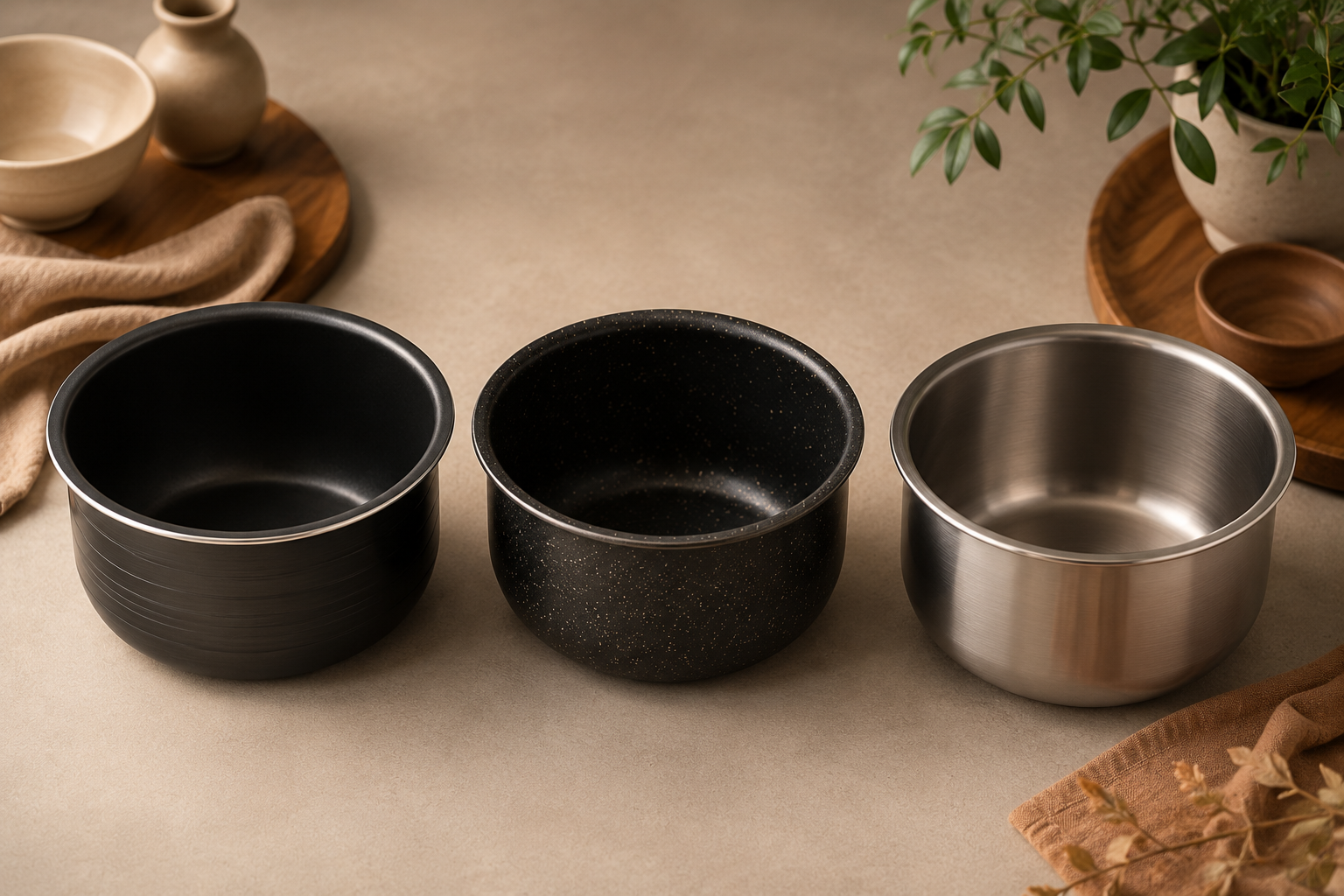
Quick Answer: What Do All Those Inner Pot Names Mean?
Brands give their inner pots dramatic names — Diamond Kamado, Black Thick, Binchotan, Platinum, 0 Coating — but they all come down to two things: how the pot is built (thickness and shape) and what it is coated with. Here is the short version:
- Best heat & even cooking: thick, multi-layer pots — Zojirushi and Panasonic Diamond Kamado.
- Sweetest rice: Platinum coating — Zojirushi NP-BSQ.
- No chemical non-stick coating: Panasonic 0 Coating stainless steel.
If you have ever compared Japanese rice cookers, you have seen the inner pot described with an intimidating list of names: "Diamond Kamado pan", "Black Thick", "Binchotan charcoal coating", "Platinum non-stick", "0 Coating stainless steel". They sound like marketing, and most shoppers nod along without really knowing what separates one from another. This guide cuts through the jargon. We explain what each material and coating actually does to your rice, brand by brand, so you can choose with confidence. Browse everything in our Japanese rice cooker collection, or start with our complete Japanese rice cooker buying guide.
Why the Inner Pot Decides Everything
The heating system gets the headlines, but the inner pot is what actually touches your rice. It has two jobs: spread heat evenly so every grain cooks at the same temperature, and release the rice cleanly without sticking or scorching. A great pot is the difference between glossy, separate grains and a gummy, scorched base. Two factors decide how well a pot does this — its construction (the metal and its thickness) and its coating (the surface layer). We will take them in turn.
Part 1: Construction — Thickness & Shape
Before any coating is applied, the pot's body does most of the work. Thicker, multi-layer metal holds more heat and spreads it gradually, so the rice never sees a sudden hot spot. Shape matters too.
Thick Multi-Layer Pots
Zojirushi's "Black Thick" pots are the clearest example. They stack several metal layers to a genuine thickness — the entry NL-DSQ uses a 4mm pot, while the NL-BGQ05 goes up to 5mm. A thicker pot behaves like a cast-iron pan: slow to heat, but rock-steady once hot, giving wonderfully even results even on an affordable Fuzzy Logic model.

Zojirushi's thick, multi-layer "Black Thick" pot holds and spreads heat like cast iron.
Toshiba goes thicker still. The RC-DX series uses a 7 mm pot — the thickest we sell — with binchotan charcoal on the outside and a diamond-and-titanium coating inside. The RC-DS series steps down to 5 mm and swaps the binchotan for copper, which heats faster but holds less. Thickness is not free: the RC-DX weighs over 7 kg and takes longer to come up to temperature.
Spherical Pots
Several Zojirushi IH rice cookers — including the NW-YAQ, NW-QAQ and mini NP-GKQ05 — use a rounded, spherical pot. The curved base creates a swirling convection current with IH heating, so the rice tumbles and cooks uniformly rather than sitting in layers. It is a key reason Zojirushi's pressure models are so prized for texture.

The rounded base creates a swirling convection current, so the rice tumbles and cooks evenly.
The "Kamado" Shape
Panasonic models its premium pots on the traditional Japanese kamado — a clay charcoal oven famous for fierce, enveloping heat. The Diamond "Kamado" pan, found on the SR-FC, SR-JHS and others, pairs that shape with multi-layer IH heating so the whole pot — sides and base — drives heat into the rice at once.

Panasonic's Diamond "Kamado" pan is modelled on a traditional Japanese clay charcoal oven.
Part 2: The Coatings, Decoded
On top of the metal sits the coating. This is where the exotic names live, and where brands differ most. Here is what each one actually does.
💎 Diamond Coating (Panasonic)
Panasonic embeds fine diamond particles in the coating of its Diamond Kamado pans. Diamond is one of the best heat conductors known, so the particles spread heat rapidly and evenly across the surface, driving it into the core of each grain for a fluffy, well-separated finish. Higher models layer this further — the SR-CR09B uses a seven-layer diamond coating to boost far-infrared heat, while the flagship SR-PAA adds a hollow, highly-insulated pan with fine bubbles for even fiercer heat.

Fine diamond particles in the coating spread heat rapidly and evenly into each grain.
🔥 Binchotan Charcoal Coating (Panasonic)
Binchotan is a premium Japanese white charcoal renowned for radiating gentle, deep far-infrared heat. Panasonic coats several pots with it to warm the rice from within, drawing out natural sweetness. You will find it on the value SR-DM, the stainless-bodied SR-AL108, and the compact SR-N072D, which adds a gold-tinted Binchotan layer and Taste Catcher technology for a richer flavour.

Binchotan charcoal coating radiates gentle far-infrared heat to draw out natural sweetness.
Toshiba uses binchotan differently. Where Panasonic coats the inside of the pot, Toshiba puts it on the outside as a far-infrared layer, and on several models adds a binchotan frame around the pot as well — so the heat radiates inwards from the pot wall rather than from the cooking surface. You will find it on the 7 mm RC-DX, the 3 mm seven-layer RC-BHH and the six-layer RC-AMXH.
⚪ Platinum Coating (Zojirushi)
This is Zojirushi's clever chemistry trick. The NP-BSQ carries a platinum-infused pot. The platinum subtly raises the alkalinity of the cooking water, which encourages the rice to break down a touch more starch into sugar — producing measurably sweeter rice. Combined with its Double Ring body heater and pressure cooking, it is one of the sweetest-tasting setups available.

Zojirushi's platinum-infused pot subtly raises water alkalinity for sweeter rice.
🍶 Ceramic & Far-Infrared Coating (Tiger)
Tiger leans on ceramic. Its flagship JPM-H uses a three-layer ceramic-coated pot, 1.7mm thick, which pairs with pressure IH to push cooking temperatures up to 106°C for springy, restaurant-grade rice. The mini JPF-A55S uses a far-infrared ceramic coating that radiates heat gently into the grains — ideal for smaller portions where even cooking is hardest to achieve.

Tiger's three-layer ceramic pot withstands the high heat of pressure IH cooking.
🧈 Fluorine Non-Stick (Tiger)
The most familiar coating of all. Tiger's everyday JBV-S Tacook uses a scratch-resistant aluminium pot with a fluorine non-stick coating. It will not transform texture the way diamond or platinum does, but it is light, wipes clean in seconds, and is built tough to resist scratches — a sensible, low-fuss choice for daily cooking.

A light, scratch-resistant non-stick pot that wipes clean in seconds.
🛡️ "0 Coating" Stainless Steel (Panasonic)
For shoppers who would rather avoid chemical non-stick layers entirely, Panasonic's 0 Coating pots — on the SR-N210D and pressure SR-N335DH — use medical-grade SUS 316L stainless steel with no non-stick coating at all. To stop rice sticking, the base is given a physical "sharkskin" texture rather than a chemical layer. The pots never wear out a coating, making them the most durable and the natural pick if food-contact safety is your priority.

Medical-grade stainless steel with a physical "sharkskin" texture — no chemical coating at all.
Will the Coating Wear Off?
Every coated pot — diamond, ceramic, platinum or fluorine — is durable, but the surface can scratch over time. To make it last: use the supplied rice paddle or a wooden/silicone spoon (never metal), wash by hand with a soft sponge, and avoid soaking rice with salt or vinegar in the pot for long periods. Stainless-steel 0 Coating pots have no coating to wear, so they tolerate rougher handling — though rice can stick more if not rinsed properly first.
Which Inner Pot Is Right for You?
| If you want… | Look for | Example |
|---|---|---|
| The sweetest rice | Platinum coating | Zojirushi NP-BSQ |
| The most even cooking | Thick or spherical pot | Zojirushi NW-YAQ |
| Fast, fierce heat | Diamond Kamado pan | Panasonic SR-FC |
| Extra natural sweetness, on a budget | Binchotan charcoal | Panasonic SR-DM |
| Springy, restaurant-grade rice | Ceramic + pressure IH | Tiger JPM-H |
| No chemical coating | 0 Coating stainless steel | Panasonic SR-N210D |
Further Reading
- Japanese Rice Cooker UK Buying Guide (Zojirushi, Tiger & Panasonic)
- Zojirushi Rice Cooker UK Buying Guide
- Zojirushi vs Tiger: Which Brand Wins?
- The Zojirushi Master Rice-Washing Technique
Frequently Asked Questions
Q: Does the inner pot coating really affect how rice tastes?
A: Yes. The pot's thickness and shape decide how evenly the rice cooks, while special coatings have specific effects — platinum raises water alkalinity for sweeter rice, Binchotan charcoal adds gentle far-infrared heat, and diamond spreads heat faster. The differences are subtle but real, especially on premium models.
Q: Which inner pot is the most durable?
A: Panasonic's 0 Coating stainless-steel pots, because there is no non-stick layer to scratch or wear away. Coated pots (diamond, ceramic, fluorine, platinum) last for years with care, but should be used with a non-metal paddle to protect the surface.
Q: Is a non-stick coating safe?
A: The coatings used by Zojirushi, Tiger and Panasonic are designed for food contact and are safe in normal use. If you prefer to avoid non-stick coatings entirely, Panasonic's 0 Coating stainless-steel pots use a physical "sharkskin" texture instead of any chemical layer.
Q: Can I buy a replacement inner pot?
A: Replacement inner pots are available for most models as spare parts. Contact us with your model number and we will help you find the correct one.
Now you know your pots — find your cooker.
Explore the full Zojirushi, Tiger and Panasonic ranges, all UK-plug ready.
Shop Japanese Rice Cookers