
Updated November 2026
Quick Answer: Which Instant Hot Water Dispenser?
- Best budget & most compact: BRUNO Instant Hot Water Dispenser — near-boiling water in seconds, white or pink. £159.90.
- Best RO-filtered value: BRUNO RO Hot Water Dispenser (BAK812) — purified hot water, compact footprint. £299.90.
- Best hot & cold: Philips RO Hot & Cold (ADD6912BL) — RO-filtered hot and chilled water. £529.90.
- Best premium (hot, cold & ice): Philips RO with Auto Ice-Maker (ADD6991WH) — hot, cold and ice at one touch. £859.90.
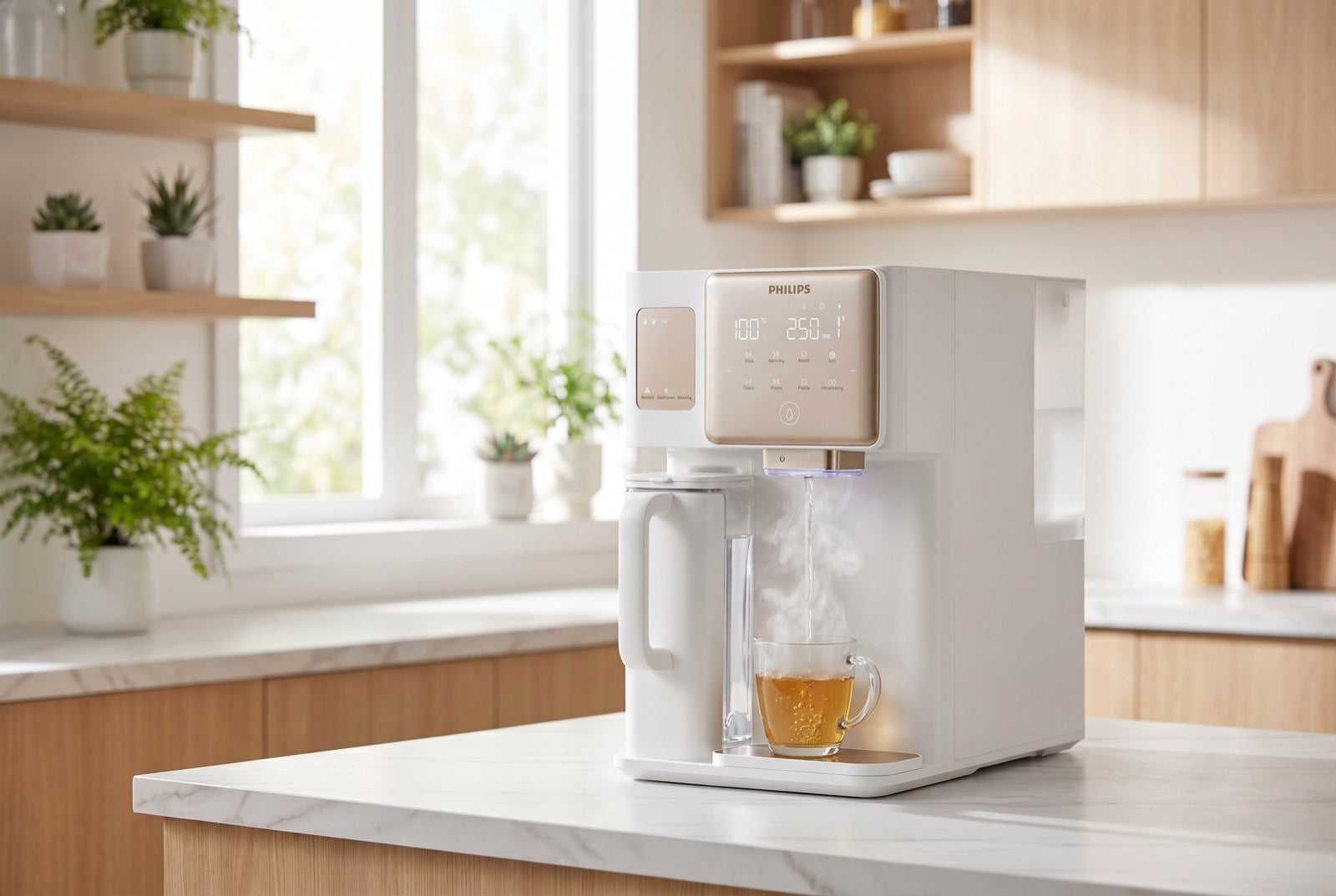
An instant hot water dispenser heats fresh water to near-boiling in seconds, cup by cup — so there's no waiting for a kettle and no re-boiling water you don't use. Many models go further, adding a built-in reverse-osmosis (RO) filter for cleaner-tasting water, plus chilled and even iced water on one machine. This guide explains the types, how to choose, and which of the dispensers we stock in the UK suits your kitchen.
The three types explained


Hot water dispenser vs kettle
A kettle heats a whole batch of water at once; an instant hot water dispenser heats water as it flows into your cup. That makes three practical differences:
- Speed. The BRUNO Instant Hot Water Dispenser starts dispensing hot water about 3 seconds after you press the button, so there's no waiting for the kettle.
- Only what you need. It dispenses 250ml at a time (or continuously), so you heat one mug rather than a full kettle. The Energy Saving Trust advises boiling only the water you need, because overfilling the kettle wastes energy. To be fair to the kettle: one filled with just a mug's worth uses a similar amount of energy. The saving comes from not overfilling.
- Temperature control. Choose room temperature, 50°C, 80°C, 90°C or 100°C. That's handy for green tea at 80°C, or coffee just off the boil.
A kettle is still the better choice if you often need a lot of boiling water at once, for example for a pan of pasta.
What does a cup cost to heat?
Heating a 250ml cup of water from about 15°C to 100°C takes roughly 0.025–0.03 kWh of electricity. That is under 1p at the Ofgem price cap average of 26.32p per kWh (1 October – 31 December 2026, Direct Debit, average for England, Scotland and Wales). Boiling a full 1.7-litre kettle for one mug heats almost seven times as much water, which costs around 4–5p. Your own cost depends on your tariff.
Models with chilled water run a small compressor to keep the cold tank cool, so they use some electricity even when you're not dispensing.
Hot water dispenser vs boiling water tap
A boiling water tap is plumbed in at your kitchen sink, with a heated tank in the cupboard below, and usually needs professional installation. A countertop dispenser simply sits on the worktop and plugs into a standard UK socket. You fill it from a removable tank, so it needs no plumber, suits renters and can move house with you.
A tap saves worktop space and never needs refilling. A dispenser needs no installation, and an RO model also gives you filtered (and on some models chilled) water without any plumbing.
How to choose
Filtration: RO or not?
A reverse-osmosis filter forces water through an ultra-fine membrane, removing limescale, chlorine taste and most dissolved impurities for cleaner, better-tasting water. If you only need boiling water for tea and coffee, a simple instant-hot model is enough; if you want purified drinking water too, choose an RO model.
Temperature options
Decide whether you need hot only, hot & cold, or hot, cold and ice. More temperatures mean more convenience — but also a bigger machine (see below).
Size & worktop space
This one catches people out. Models that chill water have a built-in compressor and a separate cold-water tank, so they are noticeably larger and deeper than hot-only units. Before you buy, measure your worktop and check the product dimensions — especially the height if the dispenser sits under a wall cabinet.
Hygiene & UV
Some hot & cold models add UV sterilisation to keep the chilled-water tank free of bacteria — worth looking for if you'll use the cold function a lot, since cold water sits in the tank longer than hot.
UK power
Every dispenser we sell is genuine 220–240V with a fitted UK 3-pin plug — no transformer or adapter needed. All are countertop designs that fill from a removable tank, so there's nothing to plumb in.
Our top picks


Compare the range
| Model | RO filter | Hot | Cold | Ice | Price |
|---|---|---|---|---|---|
| BRUNO Instant Hot (BAK801) | — | ✓ | — | — | £159.90 |
| BRUNO RO Hot (BAK812) | ✓ | ✓ | — | — | £299.90 |
| Philips RO Hot (ADD6901) | ✓ | ✓ | — | — | £339.90 |
| Toshiba RO Hot (TSR76) | ✓ | ✓ | — | — | £439.90 |
| Philips RO Hot & Cold (ADD6912BL) | ✓ | ✓ | ✓ | — | £529.90 |
| Toshiba RO Hot & Cold (W2265) | ✓ | ✓ | ✓ | — | £599.90 |
| Philips RO Hot & Cold (ADD6921DG) | ✓ | ✓ | ✓ | — | £669.90 |
| Philips RO Hot/Cold/Ice (ADD6991WH) | ✓ | ✓ | ✓ | ✓ | £859.90 |
Living with an RO water dispenser: what to expect
RO-filtered dispensers are wonderfully convenient, but there are two things every owner should understand up front — neither is a fault, just how the technology works.
Reverse osmosis produces some waste water
Purifying water by reverse osmosis always creates a small amount of reject (waste) water alongside the clean water, and this collects in the tank. Because of it, the dispenser automatically reminds you to change the water while roughly 1–1.5 litres still remain — you empty the tank completely and refill with fresh tap water, rather than simply topping it up, because the leftover holds the concentrated reject water. So a 6-litre tank gives you a little under 6 litres of usable water between changes. This is completely normal for RO and not a sign of a problem.
You never have to guess the right moment. The dispenser has a built-in reminder that alerts you automatically when it's the best time to change the water — so you always refill at the ideal point, without keeping an eye on the level yourself.

Descale it regularly
Like any appliance that heats water, a dispenser needs occasional descaling with citric acid to remove limescale — more often in hard-water areas of the UK. It's a simple few-minute job that keeps heating fast and the water tasting fresh. RO and CF filter cartridges are also replaceable, and we stock genuine replacements.
Genuine, UK-ready water dispensers
Every model is authentic 220–240V with a fitted UK plug and UK after-sales support.
Shop all water dispensersHow we chose
We only feature dispensers we sell and support in the UK. We compared them on what matters day to day: how quickly they deliver hot water, the temperature settings, whether they filter or chill, tank size and worktop footprint, and ongoing costs such as replacement filters (for example, the BRUNO BAK812 RO/CF filter set is £69.90). Our picks also reflect the questions and after-sales feedback we get from UK customers. Prices were checked against our shop when this guide was updated.
Frequently asked questions
Q: Do these water dispensers need plumbing or installation?
A: No. They are countertop units with a removable, refillable tank — just fill it, plug into a standard UK socket and go. There's no connection to your mains water and no plumber needed.
Q: Do RO water dispensers waste water?
A: Reverse osmosis always produces a little reject water, which stays in the tank. That's why the machine automatically reminds you to change the water while about 1–1.5 litres remain — you empty the tank and refill with fresh water rather than topping it up, because the leftover holds the concentrated reject water. You don't have to guess the timing; the built-in reminder tells you. It's normal RO behaviour, not a fault.
Q: Are hot & cold models bigger?
A: Yes. Chilling needs a built-in compressor and a separate cold-water tank, so hot & cold (and ice) models are noticeably larger than hot-only units. Measure your worktop and check the dimensions before buying.
Q: How do I clean and descale one?
A: Descale periodically with citric acid to remove limescale — more often in hard-water areas. Wipe the drip tray and tank regularly, and replace the RO/CF filter cartridges when due (we stock genuine ones).
Q: Is the chilled water hygienic?
A: Cold water sits in the tank longer than hot, so some models add UV sterilisation to keep the chilled-water tank free of bacteria. Look for this feature if you'll use the cold function often.
Q: Are they genuine and UK-compatible?
A: Every dispenser is 100% genuine, 220–240V with a fitted UK 3-pin plug, and backed by our UK after-sales support.
Q: Is a hot water dispenser cheaper to run than a kettle?
A: Heating one 250ml cup costs under 1p at current UK prices. The real saving comes from heating only what you need, rather than boiling a full kettle. See “Hot water dispenser vs kettle” above.
Written by the Happycooking UK Editorial Team — specialists in genuine Japanese and premium home appliances for UK kitchens. We sell and support every product we feature.