
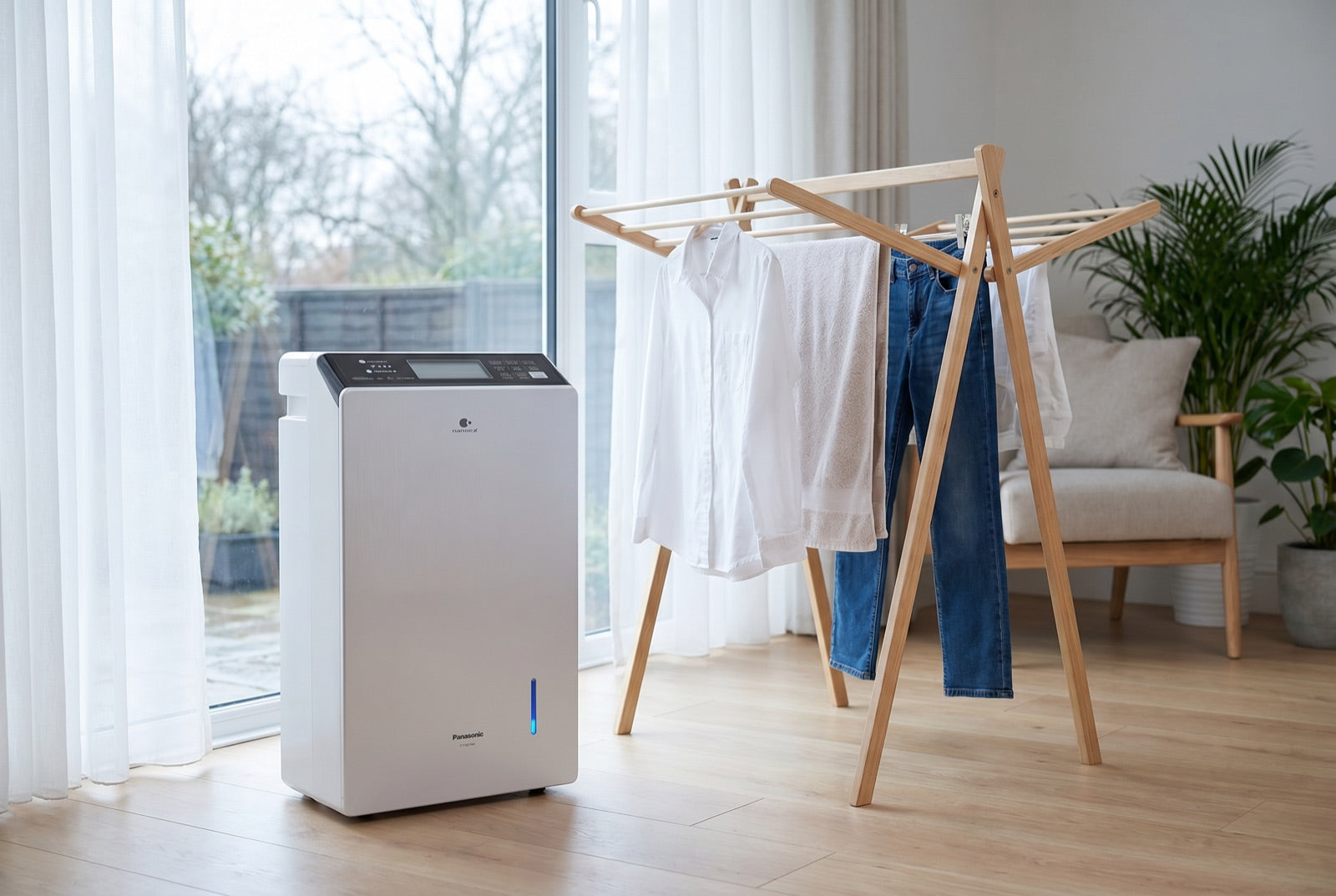
Quick Answer: Which Dehumidifier?
- Best value: Sharp DW-RN23A (13L) — DC-inverter efficiency at a friendly price. £499.90.
- Biggest capacity & best air-cleaning: Panasonic F-YVB38H (23.6L) — nanoe™ X air purification. £999.90.
- Best 2-in-1 air-purifying: Panasonic F-YAU/F-YAV (12.6–17.3L) — HEPA + nanoe. From £599.90.
- Best all-round build: Mitsubishi MJ-E series — robust Japanese engineering. From £639.90.
The UK's damp, cool climate makes a good dehumidifier one of the most useful appliances in the home — it clears condensation, helps prevent mould, dries laundry indoors and eases dust and allergens. This guide compares the genuine Japanese dehumidifiers we stock from Mitsubishi, Sharp and Panasonic, and helps you pick the right one.
Why you need a dehumidifier in a UK home
British homes battle moisture all year — steamy bathrooms, drying washing, cooking and simple cold-weather condensation on windows. Left unchecked, that damp leads to black mould, musty smells and worse allergies. A dehumidifier pulls the excess moisture from the air so your home stays drier, healthier and easier to heat — and it dries clothes indoors far faster than an airer alone.
Not sure whether a dehumidifier is the right fix for your damp? Read Does a dehumidifier help with mould? — it covers what a dehumidifier does solve, and the three damp problems it will not.
Struggling with hay fever or indoor allergies too? See our air purifiers for hay fever & allergies guide.
How to choose
Capacity (litres per day)
Capacity is measured in litres of water removed per day. As a rough guide: 10–13 L/day suits bedrooms and small rooms, 14–18 L/day suits a typical home or living area, and 20–24 L/day suits larger spaces, whole-home use or heavy indoor laundry.

Air purification
Many Japanese models clean the air as they dehumidify. Levels vary: a basic allergen/dust filter (Mitsubishi MJ-E), a HEPA filter plus nanoe™ on the Panasonic 2-in-1, or Panasonic's advanced nanoe™ X on the F-YVB38H. If you suffer with dust or allergies, a stronger air-cleaning model is worth it.
Laundry drying & energy
Every model here has a laundry / clothes-drying mode — a huge help in a UK winter — and a DC-inverter compressor that adjusts power to save energy rather than switching fully on and off.
Laundry mode is not simply the fan on full. The unit angles its airflow across the washing and pulls the evaporated moisture straight back into its own tank, so the water leaves the room instead of settling on your windows overnight. Set the airer close to the machine, close the door, and a full load typically goes from soaking to dry in an afternoon rather than two days.
How the options compare for one load:
| Method | Cost | Typical time |
|---|---|---|
|
Airer alone, no dehumidifier Every litre of water in the wash ends up in your room air — the single biggest cause of winter condensation and mould. |
Free | 24 hours+ |
|
Airer + dehumidifier on laundry mode Moisture is captured in the tank rather than released into the room. Dries the washing and protects the house. |
18–38p | 3–5 hours |
|
Heat-pump tumble dryer Gentle on fabrics and reasonably efficient, but a significant purchase and it only does laundry. |
31–52p | 3–4 hours |
|
Condenser tumble dryer Fastest option, but the most expensive to run and the hardest on clothes. |
78p–£1.31 | About 2 hours |
Costs at 26.11p/kWh (Ofgem price cap, 1 July to 30 September 2026). Drying times are typical for a full load and vary with room temperature and how heavily the wash is spun.
The point most comparisons miss is that a dehumidifier is doing two jobs at once. A tumble dryer only dries clothes; a dehumidifier dries the clothes and removes the humidity that would otherwise show up as condensation on your windows the next morning. Full running-cost figures for every model here are in our dehumidifier running cost guide.
The brands: Mitsubishi vs Sharp vs Panasonic
- Mitsubishi dehumidifiers — robust, made-in-Japan engineering across a full range, from the compact MJ-E (10/13L) to the MJ-EV/MJ-E (16/23L) and the premium air-purifying BIKUKAN series with deodorising.
- Sharp — excellent value, with the compact DC-inverter DW-RN23A (13L).
- Panasonic — leaders in air technology, with nanoe™ purification across the high-capacity F-YVB38H (23.6L) and the 2-in-1 air-purifying F-YAU/F-YAV.
Our top picks


Compare the range
| Model | Capacity | Air cleaning | Price |
|---|---|---|---|
| Sharp DW-RN23A | 13 L/day | Filter | £499.90 |
| Mitsubishi MJ-E | 10 / 13 L/day | Allergen filter | £639.90–£699.90 |
| Mitsubishi MJ-EV/E | 16 / 23 L/day | Allergen filter | £769.90–£899.90 |
| Mitsubishi BIKUKAN | 14.2 / 15.5 / 23 L/day | Deodorising air-purifying | £799.90–£969.90 |
| Panasonic F-YAU/F-YAV (2-in-1) | 12.6 / 14.6 / 17.3 L/day | HEPA + nanoe™ | £599.90–£899.90 |
| Panasonic F-YVB38H | 23.6 L/day | nanoe™ X | £999.90 |
Damp bedding? Add a futon dryer
Mattresses, futons and duvets trap moisture too. A futon dryer pumps warm air through your bedding to dry and freshen it — and warms the bed on a cold night. Try the Panasonic Futon Dryer (FD-F06S1H) or the twin-nozzle Iris Ohyama FK-W2 (both £189.90). They also dry shoes and airing cupboards.


Genuine Japanese dehumidifiers
Mitsubishi, Sharp & Panasonic — authentic UK-spec 220–240V with UK after-sales support.
Shop dehumidifiersFrequently asked questions
Q: What size dehumidifier do I need?
A: Roughly, 10–13 L/day for bedrooms and small rooms, 14–18 L/day for a typical home, and 20–24 L/day for larger spaces, whole-home use or heavy indoor laundry. A little more capacity dries faster.
Q: Mitsubishi vs Sharp vs Panasonic — which is best?
A: Sharp is the best value; Panasonic leads on air purification (nanoe™ and 2-in-1 models); Mitsubishi offers robust engineering across a full range including the premium BIKUKAN. Choose by capacity, air-cleaning needs and budget.
Q: Can a dehumidifier dry my washing indoors?
A: Yes — every model here has a laundry / clothes-drying mode, which dries clothes on an airer far faster than air alone and helps prevent the damp and condensation that indoor drying causes.
Q: Will a dehumidifier help with mould and allergies?
A: Lowering humidity discourages mould and dust mites, and air-purifying models (with filters, HEPA or nanoe™) further reduce dust and allergens — helpful if you're sensitive.
Also see how to stop condensation on windows.
Q: Are they energy efficient?
A: Yes — all use a DC-inverter compressor that adjusts power to the room rather than switching fully on and off, which saves energy over a basic dehumidifier.
See exactly what each model costs to run at the current UK price cap.
Q: Are they genuine and UK-ready?
A: Every dehumidifier is 100% genuine, UK-spec 220–240V with a fitted UK plug, and backed by our UK after-sales support.
Written by the Happycooking UK Editorial Team — specialists in genuine Japanese and premium home appliances for UK homes. We test, use and support every product we sell.
Ready to choose? Browse our full range of Japanese dehumidifiers — Mitsubishi, Panasonic and Sharp, 10–23L/day, all 220–240V with a UK plug.