
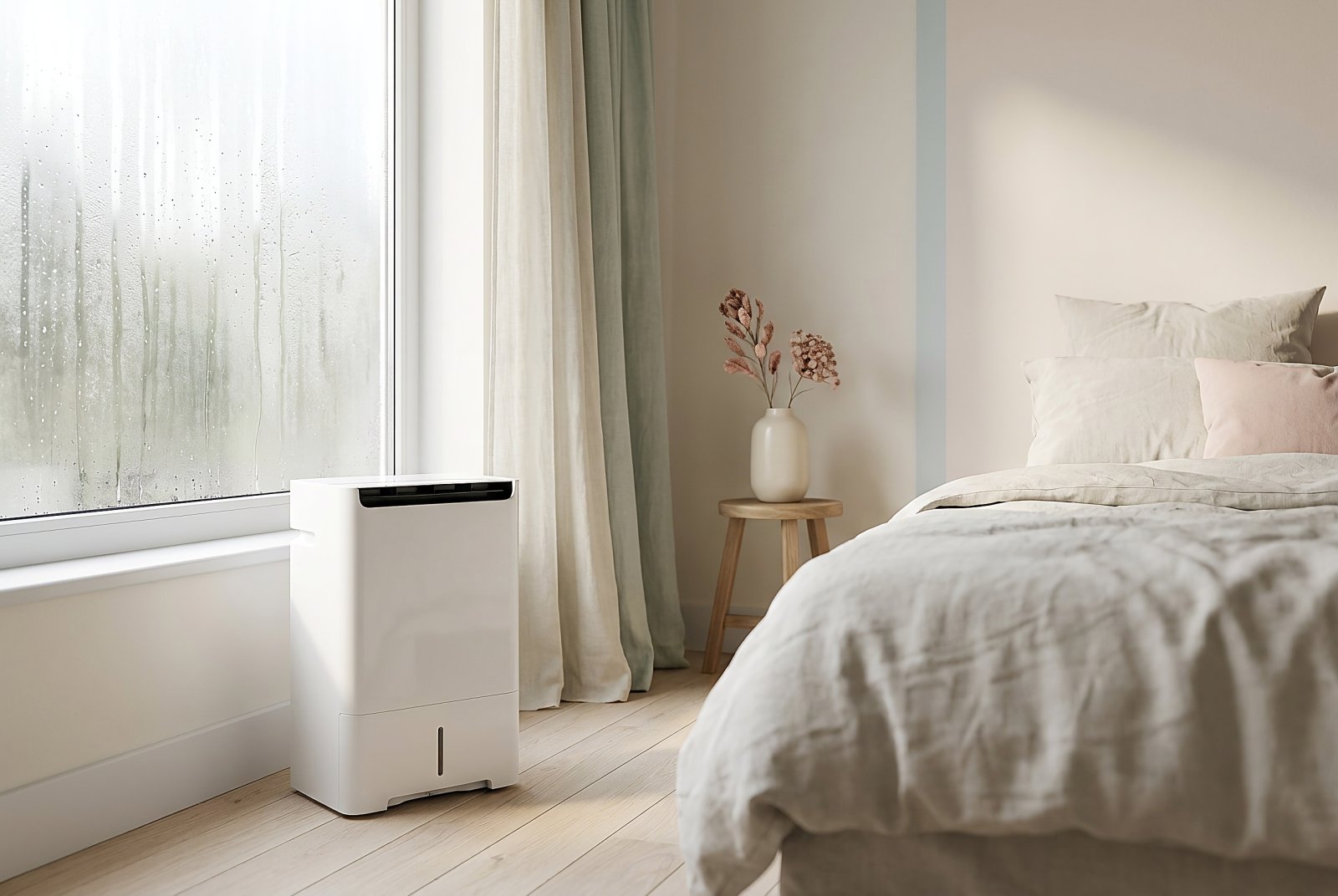
Quick Answer: Does a Dehumidifier Help With Mould?
- Yes — for prevention. Mould needs moisture. Remove the moisture and it cannot establish or spread.
- No — it will not kill mould you already have. Clean existing growth off first, then keep the room dry so it stays gone.
- Target 45–55% relative humidity. That is the band where surfaces stay dry enough for spores to fail.
- It will not fix rising damp or a leak. If a patch has a tide mark or worsens after rain, that is a building fault, not an air problem.
- Sizing: 10–13L/day for a bedroom or small flat · 14–17L/day for a three-bed house · 23L/day+ for larger or persistently damp homes.
The short answer
A dehumidifier is one of the most effective things you can put in a damp British home, but it works on the cause of mould rather than the mould itself. Mould spores are already in the air of every house in the country — they are harmless until they land somewhere damp enough to germinate. By pulling relative humidity down into the 45–55% band, a dehumidifier keeps walls, window reveals and wardrobe backs dry enough that those spores never get started.
What it will not do is scrub away the black patch that is already in the corner of your bedroom, and it will not stop water that is arriving through the fabric of the building. Both of those need a different fix, and we cover how to tell the difference below.
Why mould grows in UK homes
A typical household puts several litres of water into the air every single day — cooking, showering, washing up, drying laundry indoors, and simply breathing. In summer that moisture drifts out through open windows. In a British winter the heating is on, the windows are shut, and it has nowhere to go.
It then finds the coldest surface in the room and condenses there: single-glazed windows, the reveal around a window frame, an uninsulated external wall, or the back of a wardrobe pushed flat against one. Those cold spots stay wet, and mould follows. This is why mould so often appears behind furniture and in corners rather than in the middle of a warm wall.
What a dehumidifier does — and what it doesn't
| A dehumidifier will | A dehumidifier won't |
|---|---|
| Stop condensation forming on windows and cold walls | Kill or remove mould that has already grown |
| Prevent new mould by keeping surfaces dry | Cure rising damp or a failed damp-proof course |
| Dry laundry indoors without soaking the room | Stop a roof, gutter or plumbing leak |
| Reduce musty smells and dust-mite activity | Replace bathroom or kitchen extraction |
The number that matters: 45–55%
Mould needs sustained moisture at a surface to germinate. Keeping a room's relative humidity between 45% and 55% keeps those surfaces below the threshold, which is why every model we sell has a humidistat rather than a simple on/off switch: you set a target and the machine holds it.
There is no advantage in going lower. Below roughly 40% the air begins to feel dry — static, dry throat, shrinking timber — and you are paying for electricity that buys you nothing. A cheap hygrometer is a worthwhile companion purchase if you want to see what your rooms are actually doing.
Relative humidity in a UK home. Mould needs sustained moisture at a surface — holding a room at 45–55% keeps surfaces below that threshold.
When a dehumidifier is not the answer
This is the part most articles skip, and it matters, because buying the wrong solution wastes both money and months.
If your mould appears on cold surfaces and in still corners, is worse in winter, and eases when you ventilate, a dehumidifier will make a real difference.
Wet windows every morning is the most visible form of this. We set out the practical fixes, from free to most effective, in how to stop condensation on windows.
How to actually use one to stop mould coming back
- Clean the existing mould first. A dehumidifier does not remove it. Deal with what is there, then keep the room dry so it does not return.
- Set a target, not "on". 50% is a sensible default for a UK home.
- Put it where the moisture is made. The room with the drying rack, or the bedroom with the cold external wall — not the hallway.
- Close the door. A dehumidifier drying one room works; a dehumidifier trying to dry the whole house through open doors does not.
- Pull furniture off cold external walls. Even 5cm of air gap stops the dead spot behind a wardrobe.
- Use laundry mode when drying washing. It directs airflow at the clothes and takes the moisture straight back out, instead of letting it settle on your windows overnight.

Laundry mode directs airflow at the washing and takes the moisture straight back out of the room, instead of letting it settle on your windows overnight.
Which type works best for mould?
Compressor models are the efficient choice in a heated home and run quietly enough for a bedroom. Hybrid and inverter models switch method according to room temperature, so they keep working in an unheated garage, conservatory or utility room in mid-winter — exactly the cold spaces where condensation mould is worst.
Air-purifying models add filtration on top, so the same appliance also captures airborne spores and dust while it dries the room. If mould is your specific concern rather than general damp, this is the type to look at.


Choosing between brands and capacities in more detail? Our Best Japanese Dehumidifiers UK guide compares Mitsubishi, Sharp and Panasonic side by side, or browse the full range of Japanese dehumidifiers.
Stop the damp before the mould starts
Genuine Japanese dehumidifiers — Mitsubishi, Panasonic & Sharp. Authentic 220–240V with a fitted UK plug and UK-based warranty support.
Shop dehumidifiersFrequently asked questions
Q: Does a dehumidifier kill mould?
A: No. A dehumidifier does not kill mould that has already grown, and it will not clean it off a surface. What it does is lower the humidity that mould needs to survive and spread, so existing growth stops advancing and new patches are far less likely to appear. Clean off what is already there first, then use the dehumidifier to stop it coming back.
Q: What humidity level stops mould?
A: Aim to keep relative humidity between 45% and 55%. Mould needs sustained moisture at a surface to germinate, and holding a room in that band keeps surfaces dry enough that spores cannot establish. Below about 40% the air starts to feel dry and uncomfortable, so there is no benefit in going lower.
Q: Should I run a dehumidifier all the time?
A: No — run it to a target, not around the clock. Every model here has a humidistat: set it to around 50%, and the unit cycles on only when the room drifts above that. In a damp UK winter that may mean several hours a day; in summer it may barely run at all. Continuous operation wastes electricity without drying the room any further.
We break the numbers down in How much does it cost to run a dehumidifier in the UK?
Q: Air purifier or dehumidifier for mould?
A: A dehumidifier, if you have to choose. An air purifier captures mould spores already floating in the air, but it does nothing about the moisture that lets them grow — so the problem returns. A dehumidifier removes the cause. Air-purifying dehumidifiers such as the Mitsubishi BIKUKAN and Panasonic 2-in-1 series do both in one appliance.
Q: Do dehumidifiers take damp out of walls?
A: Only surface moisture, and only slowly. A dehumidifier dries the air, and a damp wall will give up some moisture to that drier air over time. But it cannot stop water still arriving from outside — rising damp, a failed damp-proof course, leaking guttering or a roof leak all need repair. If a damp patch is localised, has a tide mark, or gets worse after rain, treat it as a building fault first.
Q: Will a dehumidifier help with mould in the bathroom?
A: Yes, but extraction comes first. A bathroom generates a large burst of moisture in a short time, so an extractor fan or an open window during and after a shower does most of the work. A dehumidifier then handles what is left, and is particularly useful in a bathroom with no window or a weak fan.
Q: Will a dehumidifier help with mold?
A: Yes — and "mold" and "mould" are the same thing, just spelled differently in American and British English. A dehumidifier will not kill mold that has already grown, but by holding relative humidity at 45–55% it removes the moisture the spores need to settle and spread. Clean the existing patch first, then run the dehumidifier so it does not come back.
Q: Will a dehumidifier stop mould coming back after I clean it?
A: That is exactly what it is good at. Cleaning removes the visible growth but not the conditions that caused it. If the room goes back above roughly 60% humidity, the same patch returns within weeks. Running a dehumidifier in that room — especially through autumn and winter when UK homes stay shut up — keeps the surface dry enough that regrowth stops.
Q: Does a dehumidifier help with black mould specifically?
A: Black mould (usually Stachybotrys or Cladosporium) needs sustained surface moisture, so the same rule applies: it will not remove what is already there, but it removes the conditions it needs. Black mould on a cold external wall or behind furniture is usually a condensation problem, and lowering room humidity plus leaving an air gap behind furniture is the fix. If the wall is wet rather than damp, that is penetrating damp or a leak and a dehumidifier will not solve it.
Q: Do dehumidifiers help with damp?
A: It depends which kind of damp. Condensation damp — steamed-up windows, damp corners, musty wardrobes — is caused by moisture in the air, and that is what a dehumidifier removes. Rising damp and penetrating damp come from water entering the structure, and no dehumidifier will fix the source; it will only take the edge off the symptoms while the underlying repair is done.